In July 2020 the Economist wrote that “on a per-head basis, Ireland has a good claim to be the world’s most diplomatically powerful country”. They pointed to the fact that Ireland had just pipped Canada to win a seat on the UN Security Council, that Ireland’s then finance minister had just won the race to become president of the Eurogroup (the influential club of euro-zone finance ministers), and that it had an embassy in every EU member state. It acknowledged that, unlike many European countries, Ireland carried no imperial baggage and that its history as a victim of colonialism provided it with a useful icebreaker with countries once coloured pink on Victorian maps. The fact that it was an English-speaking country with a well-established position on neutrality also helped. Finally, perhaps its biggest weapon, the Irish diaspora. An estimated 70-80 million people worldwide.
The global presence and success of Ireland’s soft diplomacy is perhaps best displayed in the run up to March 17th each year, St Patrick’s Day, with festivals and parades being held in dozens of countries across the globe from Argentina to Zimbabwe. The biggest parade globally is held in New York, attracting up to 250,000 participants and over 2 million spectators, with Chicago and Boston attracting approximately 2 million and 1 million spectators respectively. St. Patrick’s Day is big business in the USA and a huge win for Irish diplomacy and soft power.
But St. Patrick’s Day isn’t the biggest Irish festival celebrated in the USA each year. There’s a much bigger one. One in which Americans spent $10.1 billion in 2021, making it the second-biggest retail holiday in the U.S., behind only Christmas. Halloween.
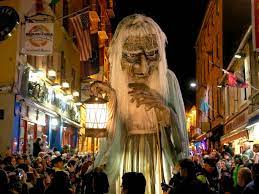
Halloween is an exported and modern day version of the Celtic and Gaelic festival of Samhain, which is held on 31 October into 1 November to mark the end of the harvest season and the beginning of winter. It’s one of four Gaelic seasonal festivals along with Imbolc, Bealtaine, and Lughnasa. Historically it was widely observed throughout former Celtic lands, including Ireland, Scotland, Galicia, the Isle of Man, Wales, Cornwall, and Brittany.
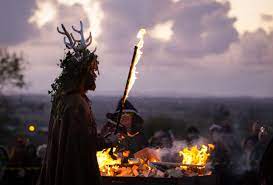
The celebration of Samhain can be traced back to the Neolithic times and several passage tombs in Ireland are aligned with the sunrises of Samhain and Imbolc. Samhain is also mentioned in early Irish literature from the 9th century and is associated with many important events in Irish mythology. Early literature refers to Samhain being marked with great gatherings and feasts, as well as bonfires and sacrifices.
Around this time of year the Celts would slaughter cattle for the winter and the Celts believed that this transition between the seasons was a bridge to the world of the dead. This bridge made it easier for the Celtic priests, the Druids, to contact the dead and to prophesise about the future. Huge bonfires would be built for people to come and offer sacrifices to the Celtic gods and to ward off evil spirits. People would also dress up, tell stories and feast. It was also believed that on this night the souls of the dead returned to earth. Food was left out to placate unwelcome visitors.
In later centuries, people began dressing as ghosts, demons, and other malevolent creatures, and performing in exchange for food and drink. This custom, known as mumming, dates back to the Middle Ages and is thought to be an antecedent of trick-or-treating.
Poor people would visit the houses of wealthier families and receive pastries called soul cakes in exchange for a promise to pray for the souls of the homeowners’ dead relatives. Known as “souling,” the practice was later taken up by children, who would go from door to door asking for gifts such as food and drink.
In Ireland and Scotland, young people took part in a tradition called guising, dressing up in costume and accepting offerings from various households. Rather than pledging to pray for the dead, they would sing a song, recite a poem, tell a joke, or perform another sort of “trick” before collecting their treat, which typically consisted of fruit, nuts, or coins.
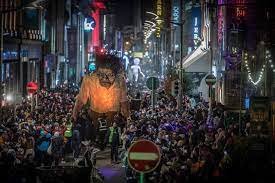
Eventually Halloween made its way to the United States with the celebration really gathering steam in the 1800s, when Irish-American immigration exploded. Borrowing from immigrant traditions, Americans began to dress up in costumes and go house to house asking for food or money, a practice that eventually became today’s “trick-or-treat” tradition.
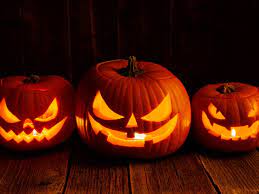
The practice of decorating jack-o’-lanterns also originated in Ireland, where large turnips and potatoes served as early canvasses. Irish immigrants brought the tradition to America, home of the pumpkin, and it became an integral part of Halloween festivities. In fact, the name, jack-o’-lantern, comes from an Irish folktale about a man named Stingy Jack.
According to the story, Stingy Jack invited the Devil to have a drink with him. True to his name, Stingy Jack didn’t want to pay for his drink, so he convinced the Devil to turn himself into a coin that Jack could use to buy their drinks. Once the Devil did so, Jack decided to keep the money and put it into his pocket next to a silver cross, which prevented the Devil from changing back into his original form.
Jack eventually freed the Devil, under the condition that he would not bother Jack for one year and that, should Jack die, he would not claim his soul. The next year, Jack again tricked the Devil into climbing into a tree to pick a piece of fruit. While he was up in the tree, Jack carved a sign of the cross into the tree’s bark so that the Devil could not come down until the Devil promised Jack not to bother him for ten more years.
Soon after, Jack died. As the legend goes, God would not allow such an unsavoury figure into heaven. The Devil, upset by the trick Jack had played on him and keeping his word not to claim his soul, would not allow Jack into hell. He sent Jack off into the dark night with only a burning coal to light his way. Jack put the coal into a carved-out turnip and has been roaming the Earth with ever since. The Irish began to refer to this ghostly figure as “Jack of the Lantern,” and then, simply “Jack O’Lantern.”
In Ireland and Scotland, people began to make their own versions of Jack’s lanterns by carving scary faces into turnips or potatoes and placing them into windows or near doors to frighten away Stingy Jack and other wandering evil spirits. In England large beets were used. Immigrants from these countries brought the jack-o’-lantern tradition with them when they arrived to the United States. They soon found that pumpkins, a fruit native to America, made perfect jack-o’-lanterns.

The “greening” of buildings every year around St. Patrick’s Day, from the pyramids of Giza to the Sydney Opera House and beyond, is a huge diplomatic achievement and advertisement for Ireland. But one can’t help wonder whether there might be an even bigger opportunity for Fáilte Ireland and Ireland’s diplomatic service to reclaim at least a shared ownership of the now truly global festival of Halloween.
Follow us on Twitter, Facebook and Instagram @eiretharlear
 Eireannach Thar Lear